
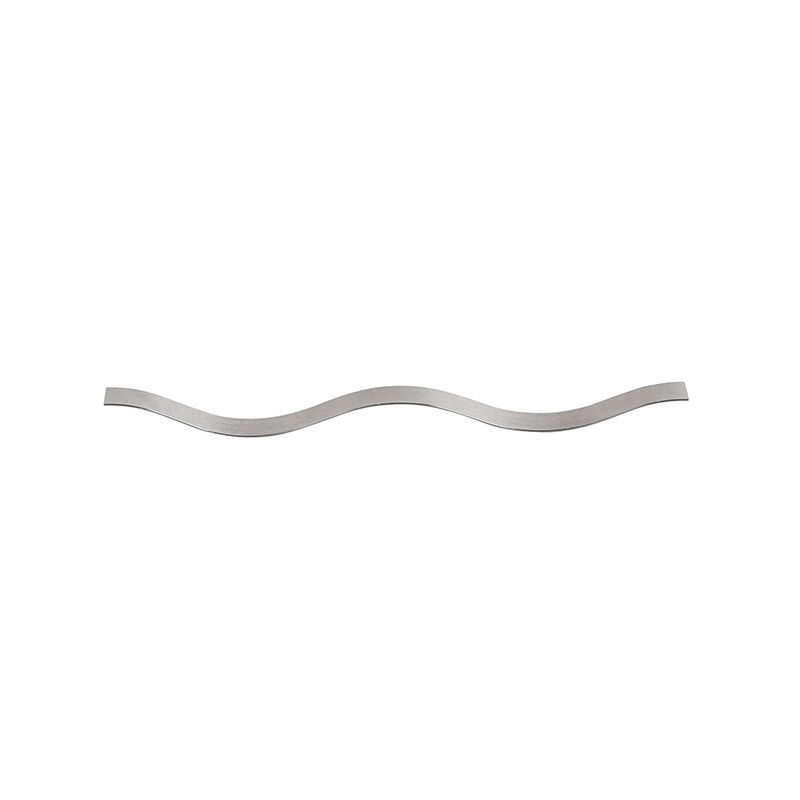
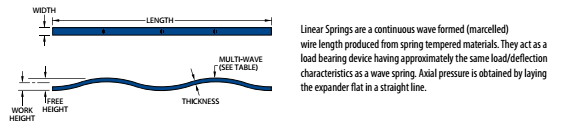
A mola de onda linear é uma formação de onda contínua com a forma de uma mola de longa duração. Como um dispositivo de suporte de carga, tem aproximadamente as mesmas características de carga e deflexão.
Compared with stamping wave spring, linear wave spring use pre-tempered raw materials and rounded edges, and the load and elastic coefficient are more accurate and predictable, 50% better than stamping parts, and the elastic coefficient is stable within the allowable deformation range.
Linear wave spring has high reliability, excellent performance, no deformation, smooth surface, no pits, scratches, breaks and other small defects. Stamped wave spring may have defects such as fatigue fracture and inaccurate loading in the subsequent manufacturing process. In terms of metallurgy, mechanical properties and dimensional stability, linear wave spring can provide higher precision quality.
A mola ondulada linear é usada para substituir a tradicional mola de arame redondo com seu potencial exclusivo de economia de espaço. O uso de mola ondulada também reduz indiretamente o espaço de montagem da mola devido à altura de trabalho reduzida da mola. Tamanho de instalação menor e menos aplicação de material resultam em uma redução de custo significativa.
Linear wave spring is particularly suitable for applications requiring weight reduction and applications limited by a small installation space. Typical application areas include: aerospace, precision machinery, hydraulic seals, and high-end motors.
Although wave springs are not very familiar to some people, you need to know that its scope of application is very wide. A wave spring is an elastic element with several peaks and valleys on a thin metal ring. Therefore, under normal circumstances, it is mainly used in occasions where the load and deformation are not large, and the spring stiffness is required to be small and the axial preload must be applied. Therefore, wave springs are especially suitable for some applications requiring weight reduction and some applications restricted by small installation space.
1. Diferentes composições de materiais.
A principal desvantagem da mola ondulada de aço carbono é que ela é fácil de enferrujar, especialmente em ambientes de alta temperatura e alta umidade. Uma vez enferrujado, a estrutura metálica do material corrói, fazendo com que o material se deforme e quebre. Portanto, se a temperatura ambiente e a umidade do produto forem altas, a mola ondulada de aço inoxidável deve ser selecionada.
2. O processo de produção é diferente.
O processo de produção de material de aço-carbono consiste em obter a elevada dureza da mola produzida pelo material de base de baixa dureza através de têmpera e revenido. Este processo resulta em fraca tenacidade e baixa vida útil dos materiais de aço-carbono e no fenómeno de fratura geral da mola em aplicações práticas. O material de aço inoxidável é obtido através de várias calandragens num moinho de metal de base de baixa dureza.
3. Diferença de preço do material.
Since the stainless steel wave spring material has a chromium content of 16-18% and a nickel content of 6%-8%, the price is 2-3 times more expensive than carbon steel. The same specification of spring, stainless steel wave spring will be about 2 times more expensive than carbon steel wave spring.
A força da mola de aço inoxidável é menor que a da mola de aço carbono, a dureza é menor que a do fio de aço carbono, mas a vida útil é longa; o fio de mola de aço carbono é mais fácil de enferrujar do que o fio de mola de aço inoxidável e possui requisitos mais altos para o ambiente de uso.
There are several common methods for surface treatment of wave springs, such as bluing, phosphating, electroplating, and electrophoresis.
Oxidation: Heat the wave spring to an appropriate temperature in air or chemicals to form a blue (or black) oxide film on the surface to improve the corrosion resistance and appearance of the wave spring.
Blackening: The same as the oxidation principle, the wave spring is heated in the air or directly immersed in a concentrated oxidizing solution to produce a very thin oxide film on the surface of the wave spring. Material protection technology.
A superfície da mola ondulada deve ser lisa, sem ferrugem, sem rebarbas, sem rachaduras e com uma camada uniforme de óxido.
Lisheng é um profissional atacadista de molas onduladas lineares, você está convidado a vir para consultar.
OIL TEMPERED(SAE1070-1090), HARD DRAWN SAE 1060 – 1075, aço inoxidável 304,316,631, 17-7PH(SUS), cobre-beríliocobre fosforoso, 65Mn, A-286, liga Inconel X-750, X-718, Elgiloy, MONEL K-500MONEL 400, etc.
Conceção → Desenho→ Nivelamento do fio → Maquinação CNC → Tratamento térmico → Superfície → Acabamento → Inspeção de qualidade → Embalagem
| Número da peça | LLS12188-1 | LLS12188-2 | LLS12188-3 | LLS12188-4 | LLS12250-1 | LLS12250-2 | LLS12250-3 | LLS12250-4 |
| Número de ondas | 1 | 2 | 3 | 4 | 1 | 2 | 3 | 4 |
| Grossura (polegada) |
0.012 | 0.012 | 0.012 | 0.012 | 0.012 | 0.012 | 0.012 | 0.012 |
| Largura (polegada) |
0.188 | 0.188 | 0.188 | 0.188 | 0.25 | 0.25 | 0.25 | 0.25 |
| Comprimento (polegada) |
1.5 | 3 | 4.5 | 6 | 1.5 | 3 | 4.5 | 6 |
| Altura Livre (polegada) |
0.225 | 0.225 | 0.225 | 0.225 | 0.225 | 0.225 | 0.225 | 0.225 |
| Carregar (Libra) |
1.5 | 5.6 | 10.4 | 14.8 | 2.2 | 7.8 | 13.9 | 19.8 |
| Altura de trabalho (polegada) |
0.125 | 0.125 | 0.125 | 0.125 | 0.125 | 0.125 | 0.125 | 0.125 |
| Taxa de Primavera (polegadas/lb) |
11 | 91 | 136 | 182 | 15 | 121 | 181 | 242 |
 Portuguese
  English
  Chinese
  Dutch
Dutch  French
  German
  Italian
  Japanese
  Korean
  Russian
  Spanish