
Introdução
When working with a rotating shaft, do you ever find the shaft unexpectedly shifting, the bearing unexpectedly moving, or the components unexpectedly loosening, which is usually caused by a tiny ring, the retaining ring? A anel de retenção, when correctly chosen and applied, resists axial movement, avoids collision damage, and maintains assemblies intact during vibration. Industrially, without these small parts, gearboxes, hydraulic valves, and car transmissions alike may confront the risk of premature breakage. This article will show you how retaining rings function, when a spiral design is preferable over a stamped snap-ring, and which materials and supplier standards are vital to long-term reliability.
What Is a Retaining Ring and Why Does Axial Control Matter?
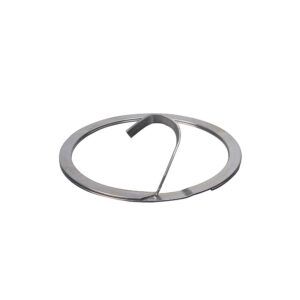
A anel de retenção (also known as a snap ring, circlip, or spiral ring) is a thin, circular fastener that sits inside a groove on a shaft or inside a housing. Its job is simple but critical: prevent parts mounted on the shaft — such as bearings, gears, pulleys, or seals — from sliding along the axis. In industrial equipment, even 0.5 mm of unintended axial movement can cause misalignment, accelerate wear on bearing races, and create noise or heat that leads to unplanned downtime.
Axial control matters because most rotating shafts are not perfectly constrained by their bearings alone. Bearings handle radial loads well but often rely on a shoulder, a nut, or a anel de retenção to hold their inner or outer ring in position. When that axial constraint fails, bearings can skid, rollers can skew, and the whole assembly loses precision. Statistics from maintenance studies show that nearly 18% of bearing failures in conveyors and pumps are linked to inadequate axial retention — often a missing or incorrectly sized anel de retenção.
How a Retaining Ring Keeps Shafts and Bearings Secure: The Mechanics
The principle is deceptively straightforward. A machined groove is cut into the shaft (or bore) at a precise location. The anel de retenção expands or compresses slightly to snap into that groove. Once seated, the ring’s radial wall resists axial thrust from the bearing or other component. The bearing pushes against the ring’s side face; the ring pushes back because the groove’s shoulder is made of stronger metal.
Unlike a welded collar or a threaded nut, a anel de retenção requires no special tools for assembly (though pliers are common for the stamped type), and it adds almost no length or weight. For example, a 2‑turn spiral anel de retenção can handle axial loads of several hundred kilograms even on a 20 mm shaft, while taking up only 1–2 mm of axial space.
Spiral Retaining Rings vs. Traditional Stamped Snap Rings – A Detailed Comparison
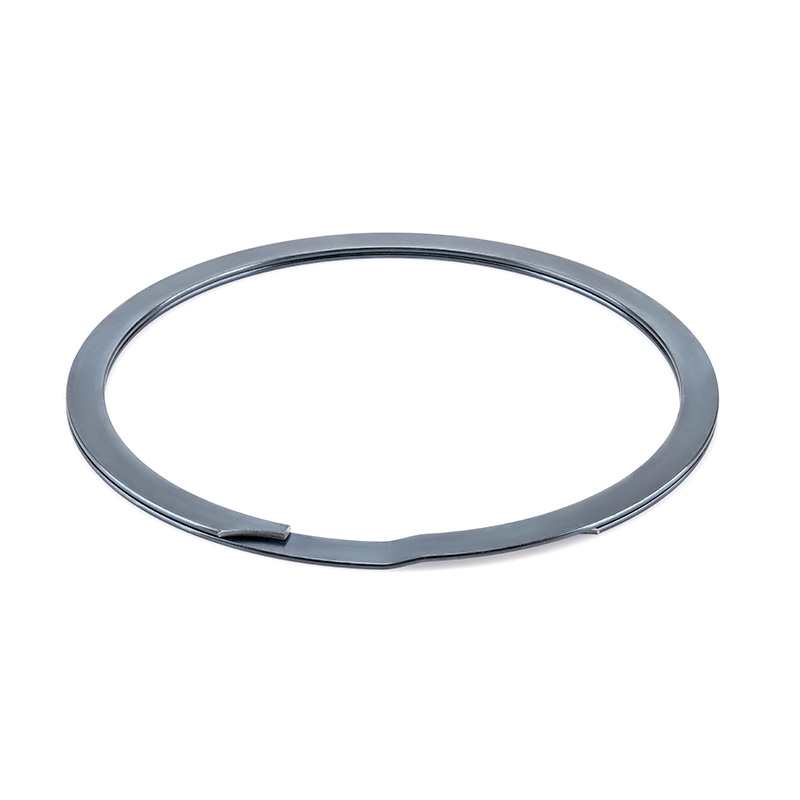
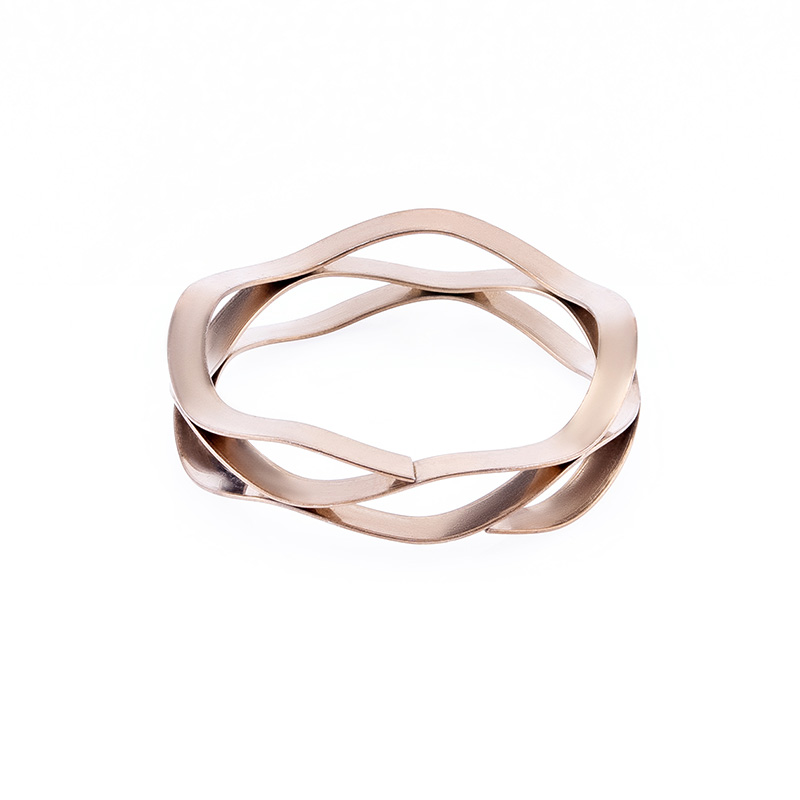
Not all anéis de retenção perform the same. The market offers two dominant designs: stamped (or “conventional”) snap rings and spiral anéis de retenção. Each has its place, but for demanding applications with rubber seals, high‑cycle fatigue, or delicate assemblies, the spiral design often wins.
| Caraterística | Stamped Snap Ring | Anel de Retenção Espiral |
|---|---|---|
| Manufacturing process | Stamped from sheet metal (like a cookie cutter) | Edge‑coiled from flat wire, no stamping dies |
| Cross‑section | Uniform thickness, often with sharp corners | Rectangular or square, with deburred edges |
| Gap | Has a large gap (ears/lug holes for pliers) | No gap – forms a continuous circumference |
| Contact with the groove | Point contact at lugs and ends | Full 360° contact (no rocking) |
| Interaction with mating parts | Sharp burrs can scratch shafts or cut rubber seals | Deburred inner/outer diameters – safe for rubber boots and O‑rings |
| Assembly/disassembly | Requires special pliers; lugs can break | Can be hand‑assembled or with simple tools; no lugs to damage |
| Load distribution | Non‑uniform – stress concentrated at lugs | Uniform – each turn shares the load |
| Ideal applications | Low‑cost consumer produtos, static assemblies | Dynamic loads, rubber‑sealed bearings, hydraulic systems |
For a specific example: a 2‑turn spiral retaining ring is often used to clamp a rubber boot onto a grease‑filled joint. Because the ring has been deburred, it will not tear the rubber, unlike a stamped snap ring whose sheared edges can act like a knife. This makes spiral anéis de retenção the preferred choice for sealed bearings, CV joints, and pneumatic cylinders.
Key Functional Advantages of Spiral Retaining Rings in Industrial Equipment
Let’s break down the operational benefits, drawing from real manufacturing data and user feedback.
1. No Gap Means No “Breathe” and No Rocking
Because a spiral anel de retenção forms a continuous circumference, it cannot expand open under load. Stamped rings have a built‑in gap that can widen if the bearing thrust is high enough, allowing the ring to partially exit the groove. In contrast, a spiral ring stays fully seated. Engineers at a mining equipment supplier reported a 40% reduction in bearing retainer failures after switching to spiral anéis de retenção on their conveyor head pulleys.
2. Smooth Inner and Outer Diameters Protect Critical Surfaces
Deburring is not a luxury — it is a necessity when your anel de retenção sits next to a dynamic seal or a precision-ground shaft. The spiral coiling process naturally produces smooth edges, and reputable manufacturers (such as Lisheng) further deburr every ring. One automotive tier‑1 supplier noted that switching to deburred spiral anéis de retenção eliminated 90% of seal leakage complaints on a steering column assembly.
3. No Tooling Cost for Custom Sizes
Stamped anéis de retenção require expensive die sets. A new size can cost $1,000–5,000 in tooling alone. Spiral rings are coiled on CNC formers – no hard tooling. Changing the wire thickness, turns (e.g., 1‑turn, 2‑turn, or 3‑turn), or diameter requires only a programming change. This means you can order custom spiral anéis de retenção for prototypes or low‑volume production without a budget blowout.
4. Tailored Strength by Varying Turns
A single‑turn spiral anel de retenção handles light axial loads. Add a second turn, and the load capacity roughly doubles. A third turn provides even greater security. This scalability is impossible with stamped rings. For example, a hydraulic valve manufacturer uses a 2‑turn spiral anel de retenção to retain a needle bearing under 2,500 N of pulsed load, while a lighter 1‑turn ring secures a potentiometer on the same shaft.
Materials, Heat Treatment, and Surface Finishes – What to Look For
The best geometry means nothing if the material fails. Industrial anéis de retenção are most commonly made from:
-
Spring steel (e.g., 65Mn, CK67) – Excellent fatigue resistance and elasticity, suitable for 80% of general industrial applications.
-
Stainless steel (301, 304, 316) – For corrosive environments (food processing, marine equipment, chemical plants). 301 offers higher strength; 316 provides superior corrosion resistance.
-
Cobre-berílio alloy – Non‑sparking, non‑magnetic, and highly conductive. Used in aerospace sensors and oil drilling tools.
-
Superalloys (Inconel, Monel) – For high‑temperature applications up to 800°C (turbines, exhaust systems).
After coiling, a quality anel de retenção undergoes heat treatment to achieve a hardness of 42–50 HRC (for spring steel) or 35–45 HRC (for stainless). Without proper tempering, the ring will take a permanent set when loaded. Also check surface finish – a plain oiled finish is fine for dry assemblies, but zinc plating or passivation adds corrosion resistance.
Pro tip from a field reliability engineer: “Always request a certificate of conformance for heat treatment. We once bought cheap anéis de retenção that failed after 200 hours because the supplier skipped tempering. Now we only buy from ISO 9001 certified makers like Lisheng.”
Real‑World User Scenarios – Where Retaining Rings Save the Day
Let’s walk through four common industrial scenarios where the right anel de retenção makes the difference between a five‑year service life and a five‑week breakdown.
Scenario 1: Hydraulic Cylinder End Cap Retention
A hydraulic cylinder needs to hold the piston rod bearing in place. The groove is located inside the cylinder tube. A stamped snap ring with sharp edges could scrape the bore surface, creating metallic contamination. The engineer selects a 3‑turn stainless steel spiral anel de retenção with deburred OD. Result: zero bore damage, and the ring withstands 400 bar pressure spikes.
Scenario 2: Rubber Boot Sealing on a Grease‑Filled Joint
As mentioned earlier, a 2‑turn spiral retaining ring clamps the rubber boot onto the groove, creating a nearly perfect seal when the boot is filled with grease. Because the ring has been deburred, it will not tear into the rubber. This application is widely used in constant‑velocity (CV) joints on agricultural machinery and heavy trucks.
Scenario 3: Valve Stem Axial Positioning
In a butterfly valve, the stem must be prevented from lifting under fluid pressure. A anel de retenção sits in a groove just above the upper bearing. The ring experiences both static axial load and slight rotation from handle torque. A 2‑turn spiral ring made of 316 stainless steel handles the corrosive media (seawater) and lasts over 500,000 cycles without fatigue cracking.
Scenario 4: Quick Connector and Pneumatic Fittings
Miniature anéis de retenção (diameters as small as 5 mm) secure locking sleeves in quick‑connect couplings. Here, low profile and smooth edges are critical because the ring slides inside a plastic housing. A stamped ring would catch on the plastic; a spiral ring glides easily. This is why many pneumatic tool manufacturers specify spiral anéis de retenção as standard.
Why Supplier Selection Matters – Experience, Quality Control, and Delivery
You can design the perfect groove and calculate the exact axial load, but if your anel de retenção supplier delivers inconsistent parts or uses sub‑standard wire, your equipment will still fail. Here is what separates a commodity trader from a true manufacturing partner.
25+ Years of Domain Experience
A company that has been making anéis de retenção for two decades understands the subtle details: how much to deburr without weakening the edge, which wire temper works best for a 2‑turn vs. 3‑turn design, and how to package rings to prevent tangling. Lisheng, for example, has been in the spring and ring business for 25 years, serving customers in America, Europe, and Australia. Longevity in this industry correlates directly with process maturity.
ISO 9001 and TS 16949 Compliance
Quality systems are not just paperwork. ISO 9001:2015 (or the newer IATF 16949 for automotive) requires documented control over raw material receiving, in‑process inspections, and final testing. A anel de retenção from an ISO‑certified supplier will have a consistent groove fit (the ring’s free diameter and gap are measured every batch). Ask your supplier for their QC profile – the best ones provide dimensional reports with every shipment.
Sample Availability and Fast Delivery
When you are prototyping a new machine, waiting six weeks for rings is a non‑starter. A responsive supplier keeps common sizes in stock and can send samples for approval within 7 days (free if standard tooling exists). For custom rings, typical lead times of 10 working days are achievable because no stamping dies are required. This speed directly shortens your development cycle.
After‑Sales Support
What happens if you receive a batch of anéis de retenção and the groove fit is 0.05 mm too tight? A good supplier answers emails within 24 hours, provides technical advice on groove adjustment, and offers replacements if the rings are out of spec. “Best after-sales service” is not a slogan – it means you do not have to shut down a production line while arguing with a distributor.
Installation and Removal Tips – Avoiding Common Mistakes
Even a perfect anel de retenção can fail if installed incorrectly. Here are three practical rules:
-
Use the correct groove dimensions. Always consult the supplier’s groove spec sheet. A groove that is too deep will let the ring roll out; a groove that is too shallow prevents full seating.
-
Do not over‑expand the ring. For spiral rings, you only need to open the coil enough to slip it over the shaft. Over‑expanding can permanently deform the helix.
-
Check for burrs in the groove. Any high spot will lift the anel de retenção locally, reducing the contact area. Deburr the groove with a fine stone before assembly.
For removal, spiral rings are often easier than stamped ones because they have no exposed lugs to break. Simply pry one end of the coil with a small flathead screwdriver, then “unscrew” the ring out of the groove. This convenience reduces maintenance time by about 30% according to field service technicians.
Perguntas frequentes
1. Can a retaining ring be reused after removal?
Generally no. Spiral rings are still a form of spring; each installation can cause a slight set. For safety‑critical applications, always install a new ring.
2. What is the maximum axial load for a 2‑turn spiral retaining ring?
It depends on the shaft diameter and material. For a 25 mm spring steel ring, the typical safe load is 4,000–6,000 N. Consult the supplier’s load table.
3. Are retaining rings suitable for high‑speed rotating shafts?
Yes, but balance is key. Spiral rings (no gap) create less imbalance than stamped rings. For speeds above 10,000 RPM, use a screw‑mounted collar instead.
4. Do I need a special pair of pliers to install a spiral retaining ring?
No – most sizes can be hand‑wound onto the shaft. For larger diameters (>80 mm), use simple retaining ring pliers without tip holes.
5. How do I prevent galvanic corrosion between the ring and shaft?
Match materials closely (e.g., 316 stainless ring with 316 shaft). For dissimilar metals, add a nylon coating on the ring or use a dielectric grease.
Conclusão
Securing shafts and bearings doesn’t require bulky locknuts or expensive machining. A well-chosen anel de retenção—especially a spiral design with deburred edges and customizable turns—provides reliable axial retention, protects seals, and extends equipment life.
Choose a trusted supplier with fast sampling, strong QC, and 25 years of experience to avoid failures from stamped rings. Visit the Lispring custom spiral retaining ring page to request a quote, get free samples within 7 days, and ensure your machinery stays precise and reliable.
 Portuguese
  English
  Chinese
  Dutch
Dutch  French
  German
  Italian
  Japanese
  Korean
  Russian
  Spanish