
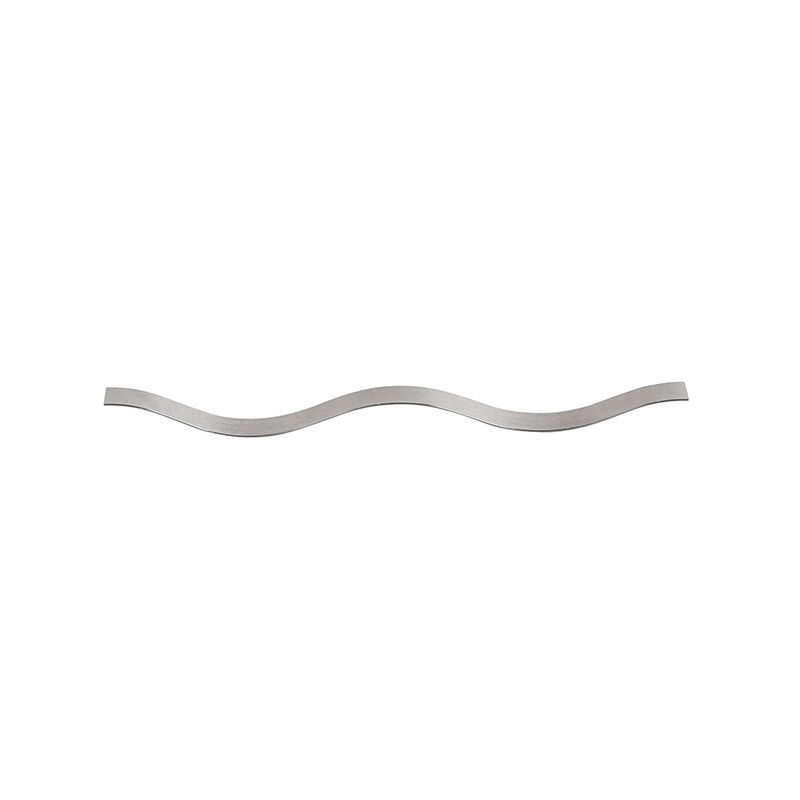
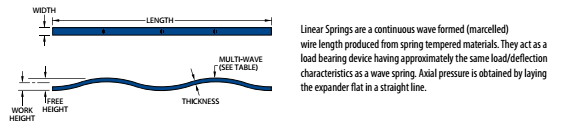
La molla ad onda lineare è un'onda continua che forma la forma di una molla a nastro lungo. Come dispositivo portante hanno all'incirca le stesse caratteristiche di carico e deflessione.
Compared with stamping wave spring, linear wave spring use pre-tempered raw materials and rounded edges, and the load and elastic coefficient are more accurate and predictable, 50% better than stamping parts, and the elastic coefficient is stable within the allowable deformation range.
Linear wave spring has high reliability, excellent performance, no deformation, smooth surface, no pits, scratches, breaks and other small defects. Stamped wave spring may have defects such as fatigue fracture and inaccurate loading in the subsequent manufacturing process. In terms of metallurgy, mechanical properties and dimensional stability, linear wave spring can provide higher precision quality.
La molla ad onda lineare viene utilizzata per sostituire la tradizionale molla a filo tondo con il suo esclusivo potenziale salvaspazio. L'uso della molla ondulata riduce anche indirettamente lo spazio di montaggio della molla a causa della ridotta altezza di lavoro della molla. Dimensioni di installazione ridotte e minore applicazione di materiale si traducono in una significativa riduzione dei costi.
Linear wave spring is particularly suitable for applications requiring weight reduction and applications limited by a small installation space. Typical application areas include: aerospace, precision machinery, hydraulic seals, and high-end motors.
Although wave springs are not very familiar to some people, you need to know that its scope of application is very wide. A wave spring is an elastic element with several peaks and valleys on a thin metal ring. Therefore, under normal circumstances, it is mainly used in occasions where the load and deformation are not large, and the spring stiffness is required to be small and the axial preload must be applied. Therefore, wave springs are especially suitable for some applications requiring weight reduction and some applications restricted by small installation space.
1. Composizione materiale differente.
Il principale svantaggio della molla ondulata in acciaio al carbonio è che è facile da arrugginire, specialmente in ambienti ad alta temperatura e alta umidità. Una volta arrugginita, la struttura metallica del materiale si corrode, provocando la deformazione e la rottura del materiale. Pertanto, se la temperatura ambiente e l'umidità del prodotto sono elevate, è necessario selezionare una molla ondulata in acciaio inossidabile.
2. Il processo di produzione è diverso.
The production process of carbon steel material is to obtain the high hardness of the spring produced by the low hardness base material through quenching and tempering. This process results in poor toughness and low service life of carbon steel materials, and the phenomenon of overall spring fracture in practical applications. The stainless steel material is obtained by several calendering by a low hardness base metal mill.
3. Differenza di prezzo del materiale.
Since the stainless steel wave spring material has a chromium content of 16-18% and a nickel content of 6%-8%, the price is 2-3 times more expensive than carbon steel. The same specification of spring, stainless steel wave spring will be about 2 times more expensive than carbon steel wave spring.
La forza elastica della molla in acciaio inossidabile è inferiore a quella della molla in acciaio al carbonio, la durezza è inferiore a quella del filo in acciaio al carbonio, ma la durata è lunga; il filo per molle in acciaio al carbonio è più facile da arrugginire rispetto al filo per molle in acciaio inossidabile e ha requisiti più elevati per l'ambiente di utilizzo.
There are several common methods for surface treatment of wave springs, such as bluing, phosphating, electroplating, and electrophoresis.
Oxidation: Heat the wave spring to an appropriate temperature in air or chemicals to form a blue (or black) oxide film on the surface to improve the corrosion resistance and appearance of the wave spring.
Blackening: The same as the oxidation principle, the wave spring is heated in the air or directly immersed in a concentrated oxidizing solution to produce a very thin oxide film on the surface of the wave spring. Material protection technology.
La superficie della molla ondulata deve essere liscia, priva di ruggine, sbavature, crepe e uno strato di ossido uniforme.
Lisheng è un professionista grossista di molle ad onda lineare, siete invitati a venire a consultare.
OIL TEMPERED(SAE1070-1090), HARD DRAWN SAE 1060 – 1075, acciaio inox 304,316,631, 17-7PH(SUS), rame berillio, phosphor copper, 65Mn, A-286, Inconel Alloy X-750, X-718, Elgiloy, MONEL K-500, MONEL 400 etc.
Design → Drawing→ Flat the wire → CNC Machining → Heat treatment → Surface → Finishing → Quality Inspection → Packing
| Numero parte | LLS12188-1 | LLS12188-2 | LLS12188-3 | LLS12188-4 | LLS12250-1 | LLS12250-2 | LLS12250-3 | LLS12250-4 |
| Numero di onde | 1 | 2 | 3 | 4 | 1 | 2 | 3 | 4 |
| Spessore (pollice) |
0.012 | 0.012 | 0.012 | 0.012 | 0.012 | 0.012 | 0.012 | 0.012 |
| Larghezza (pollice) |
0.188 | 0.188 | 0.188 | 0.188 | 0.25 | 0.25 | 0.25 | 0.25 |
| Lunghezza (pollice) |
1.5 | 3 | 4.5 | 6 | 1.5 | 3 | 4.5 | 6 |
| Altezza libera (pollice) |
0.225 | 0.225 | 0.225 | 0.225 | 0.225 | 0.225 | 0.225 | 0.225 |
| Carico (libbre) |
1.5 | 5.6 | 10.4 | 14.8 | 2.2 | 7.8 | 13.9 | 19.8 |
| Altezza di lavoro (pollice) |
0.125 | 0.125 | 0.125 | 0.125 | 0.125 | 0.125 | 0.125 | 0.125 |
| Indice di rigidezza (pollici/libbre) |
11 | 91 | 136 | 182 | 15 | 121 | 181 | 242 |
 Italian
  English
  Chinese
  Dutch
Dutch  French
  German
  Japanese
  Korean
  Portuguese
  Russian
  Spanish