
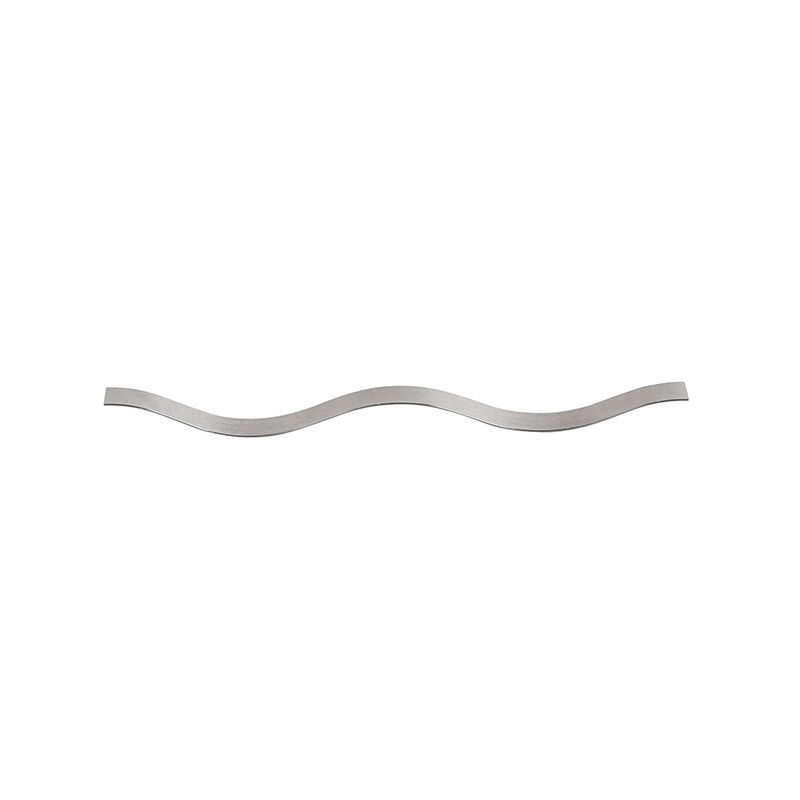
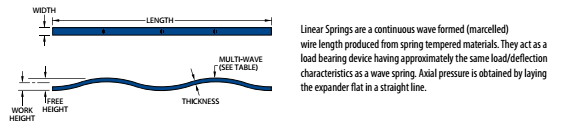
Bei einer linearen Wellenfeder handelt es sich um eine kontinuierliche Welle, die die Form einer Langstreifenfeder hat. Als Lastaufnahmemittel haben sie ungefähr die gleichen Last- und Durchbiegungseigenschaften.
Compared with stamping wave spring, linear wave spring use pre-tempered raw materials and rounded edges, and the load and elastic coefficient are more accurate and predictable, 50% better than stamping parts, and the elastic coefficient is stable within the allowable deformation range.
Linear wave spring has high reliability, excellent performance, no deformation, smooth surface, no pits, scratches, breaks and other small defects. Stamped wave spring may have defects such as fatigue fracture and inaccurate loading in the subsequent manufacturing process. In terms of metallurgy, mechanical properties and dimensional stability, linear wave spring can provide higher precision quality.
Lineare Wellenfedern werden verwendet, um herkömmliche Runddrahtfedern mit ihrem einzigartigen Platzsparpotenzial zu ersetzen. Durch die Verwendung einer Wellenfeder wird aufgrund der geringeren Arbeitshöhe der Feder indirekt auch der Platz für die Federmontage verringert. Kleinere Baugröße und geringerer Materialeinsatz führen zu einer deutlichen Kostenreduzierung.
Linear wave spring is particularly suitable for applications requiring weight reduction and applications limited by a small installation space. Typical application areas include: aerospace, precision machinery, hydraulic seals, and high-end motors.
Although wave springs are not very familiar to some people, you need to know that its scope of application is very wide. A wave spring is an elastic element with several peaks and valleys on a thin metal ring. Therefore, under normal circumstances, it is mainly used in occasions where the load and deformation are not large, and the spring stiffness is required to be small and the axial preload must be applied. Therefore, wave springs are especially suitable for some applications requiring weight reduction and some applications restricted by small installation space.
1. Unterschiedliche Materialzusammensetzung.
Der Hauptnachteil der Wellenfeder aus Kohlenstoffstahl besteht darin, dass sie leicht rostet, insbesondere in Umgebungen mit hohen Temperaturen und hoher Luftfeuchtigkeit. Sobald es verrostet ist, korrodiert die Metallstruktur des Materials, wodurch sich das Material verformt und bricht. Wenn die Umgebungstemperatur und die Luftfeuchtigkeit des Produkts hoch sind, sollte daher eine Wellenfeder aus Edelstahl gewählt werden.
2. Der Produktionsprozess ist anders.
Das Herstellungsverfahren von Kohlenstoffstahl besteht darin, die hohe Härte der Feder durch Vergüten des niedrigharten Grundmaterials zu erreichen. Dieses Verfahren führt zu einer schlechten Zähigkeit und einer geringen Lebensdauer der Kohlenstoffstahlwerkstoffe sowie zum Phänomen des allgemeinen Federbruchs in praktischen Anwendungen. Der nichtrostende Stahl wird durch mehrfaches Kalandrieren eines Grundmetalls mit niedriger Härte hergestellt.
3. Materialpreisunterschied.
Since the stainless steel wave spring material has a chromium content of 16-18% and a nickel content of 6%-8%, the price is 2-3 times more expensive than carbon steel. The same specification of spring, stainless steel wave spring will be about 2 times more expensive than carbon steel wave spring.
Die Federkraft einer Edelstahlfeder ist geringer als die einer Kohlenstoffstahlfeder, die Härte ist geringer als die eines Kohlenstoffstahldrahts, aber die Lebensdauer ist lang; Federdraht aus Kohlenstoffstahl rostet leichter als Federdraht aus Edelstahl und stellt höhere Anforderungen an die Einsatzumgebung.
There are several common methods for surface treatment of wave springs, such as bluing, phosphating, electroplating, and electrophoresis.
Oxidation: Heat the wave spring to an appropriate temperature in air or chemicals to form a blue (or black) oxide film on the surface to improve the corrosion resistance and appearance of the wave spring.
Blackening: The same as the oxidation principle, the wave spring is heated in the air or directly immersed in a concentrated oxidizing solution to produce a very thin oxide film on the surface of the wave spring. Material protection technology.
Die Oberfläche der Wellenfeder sollte glatt sein, kein Rost, keine Grate, keine Risse und eine gleichmäßige Oxidschicht aufweisen.
Lisheng ist ein Profi Großhändler für lineare Wellenfedern, kommen Sie gerne zu einer Beratung vorbei.
OIL TEMPERED(SAE1070-1090), HARD DRAWN SAE 1060 – 1075, Edelstahl 304,316,631, 17-7PH(SUS), BerylliumkupferPhosphorkupfer, 65Mn, A-286, Inconel-Legierung X-750, X-718, Elgiloy, MONEL K-500, MONEL 400 usw.
Entwurf → Zeichnung→ Flachdraht → CNC-Bearbeitung → Wärmebehandlung → Oberfläche → Endbearbeitung → Qualitätskontrolle → Verpackung
| Artikelnummer | LLS12188-1 | LLS12188-2 | LLS12188-3 | LLS12188-4 | LLS12250-1 | LLS12250-2 | LLS12250-3 | LLS12250-4 |
| Anzahl der Wellen | 1 | 2 | 3 | 4 | 1 | 2 | 3 | 4 |
| Dicke (Zoll) |
0.012 | 0.012 | 0.012 | 0.012 | 0.012 | 0.012 | 0.012 | 0.012 |
| Breite (Zoll) |
0.188 | 0.188 | 0.188 | 0.188 | 0.25 | 0.25 | 0.25 | 0.25 |
| Länge (Zoll) |
1.5 | 3 | 4.5 | 6 | 1.5 | 3 | 4.5 | 6 |
| Freie Höhe (Zoll) |
0.225 | 0.225 | 0.225 | 0.225 | 0.225 | 0.225 | 0.225 | 0.225 |
| Belastung (Pfund) |
1.5 | 5.6 | 10.4 | 14.8 | 2.2 | 7.8 | 13.9 | 19.8 |
| Arbeitshöhe (Zoll) |
0.125 | 0.125 | 0.125 | 0.125 | 0.125 | 0.125 | 0.125 | 0.125 |
| Federrate (Zoll/lb) |
11 | 91 | 136 | 182 | 15 | 121 | 181 | 242 |
 German
  English
  Chinese
  Dutch
Dutch  French
  Italian
  Japanese
  Korean
  Portuguese
  Russian
  Spanish