
Wave washers are an important component widely used in the machinery manufacturing industry. They are metal washers with elastic structures and are mainly used for connector pre-tightening, vibration reduction and space-constrained occasions. Compared with other spring washers, wave washers can provide stable and controllable elastic force in a limited axial space, and are also indispensable components in the fields of electronics, electrical, automotive, precision engineering, etc.
Related hot searches:gap wave spring、overlap wave spring、multi turn wave springs
What is a wave washer?
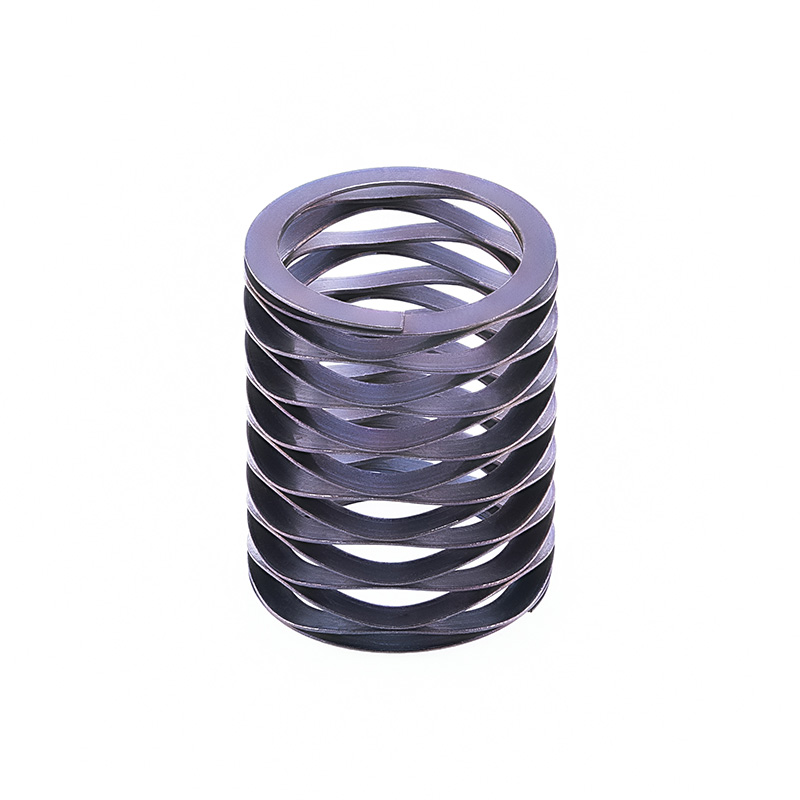
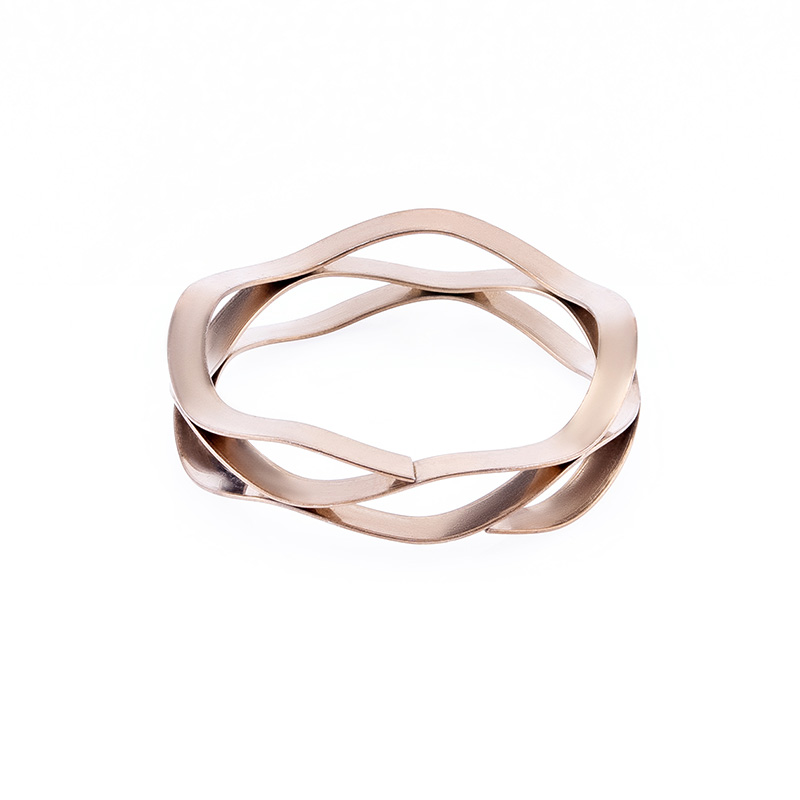
Wave washer is a thin metal washer with a wavy shape, which provides axial load through its elastic structure. It belongs to the family of elastic washers and is often used to prevent bolts from loosening or to provide pre-tightening force for bearings.
Core features:
The wave design can achieve compression and generate elastic restoring force;
The materials are mostly carbon steel, stainless steel, copper alloy or high-temperature alloy;
It is suitable for high-frequency use in small spaces, especially under conditions of thermal expansion and contraction and frequent vibration.
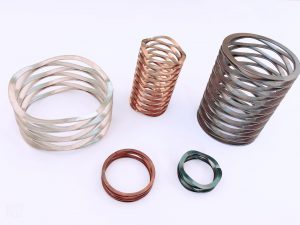
Uses of wave washers
| Application | Description |
| Electronics (PCBs) | Provides light preload to prevent loosening from thermal expansion |
| Automotive Bearings | Preloads bearing sets to reduce noise and improve life |
| Medical & Aerospace Devices | Prevents axial clearance shifts in precision components |
| Industrial Assemblies | Used for vibration absorption, shock dampening, and assembly stability |
Wave Washer Dimensions
| Specification | Description |
| Outer Diameter (OD) | External measurement of the washer |
| Inner Diameter (ID) | Fits onto shaft or screw |
| Thickness (T) | Washer thickness |
| Free Height (H) | Uncompressed height |
| Number of Waves | Typically 3, 4, or 6 |
Common size range: OD 6mm–60mm, thickness 0.2mm–1.5mm, customizable for special applications.
Wave washer load calculation formula (simplified)
The relationship between the axial force and compression of the wave washer can be estimated approximately using the following method:
F=k*Δx
Where: F is the axial load (N);
k is the equivalent stiffness coefficient (N/mm), which is determined by the number of waves, material, and thickness;
Δx is the compression (mm).
Example:
If the stiffness of a wave washer is 70 N/mm and the compression is 0.6mm, its load is:
F=70×0.6=42N
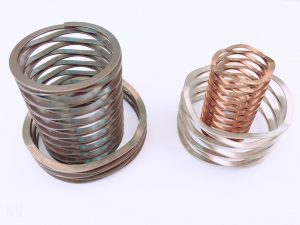
Line chart of wave washer load change
The following is a diagram of the load change of the wave washer under different compression amounts:
| Compression (mm) | Axial Load (N) |
| 0.0 | 0 |
| 0.2 | 15 |
| 0.4 | 30 |
| 0.6 | 50 |
| 0.8 | 70 |
| 1.0 | 85 |
The line chart is as follows:
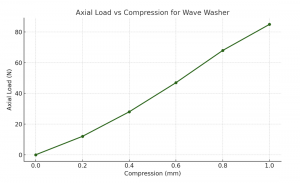
The figure above shows the axial load variation trend of the wave washer under different compression amounts:
The curve shows an upward trend, indicating that the more compression, the greater the axial load;
It increases faster between 0.4 mm and 1.0 mm, indicating that this compression range is the main elastic working area;
It can be used to determine the safe compression range of the preload design to avoid overpressure or insufficient load.
The difference between wave washers and spring washers
| Feature | Wave Washer | Spring Lock Washer |
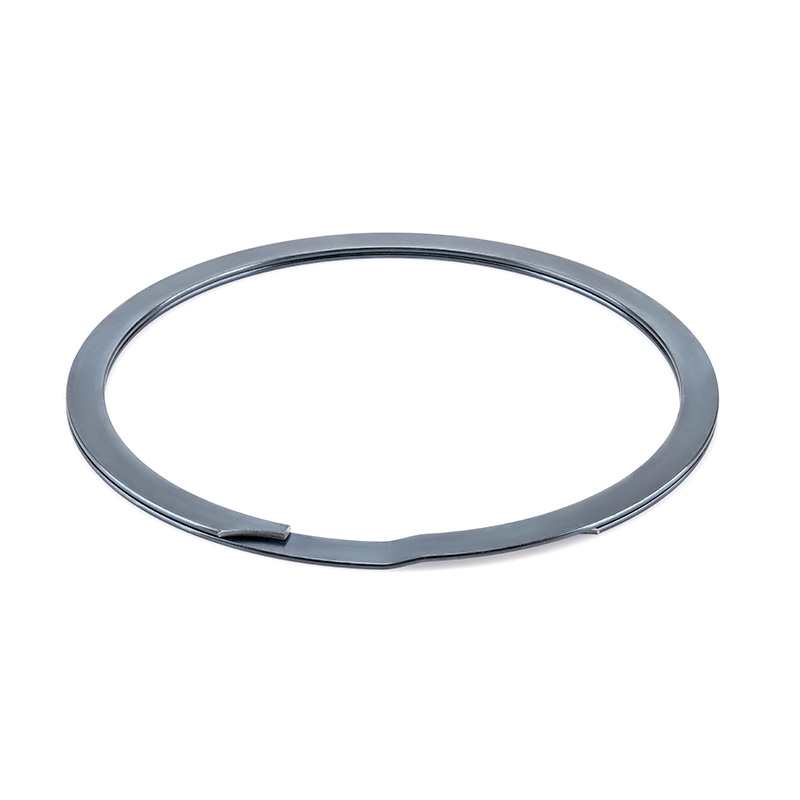
| Shape | Wavy disc | Helical split ring |
| Axial Load Function | Provides controlled elastic preload | Primarily prevents bolt rotation |
| Application | Precision preload and damping | General-purpose fastener retention |
| Space Suitability | Great for tight axial space | Good for compact general setups |
Advantages and disadvantages of wave washers vs spring washers
| Comparison | Wave Washer | Spring Lock Washer |
| Vibration Absorption | ✅ Excellent | ❌ Poor |
| Load Distribution | ✅ Uniform | ❌ Localized points |
| Installation Ease | ✅ Simple | ✅ Simple |
| Reusability | ✅ Reusable | ⚠️ Limited due to wear |
| Cost | ⚠️ Medium to High | ✅ Low |
Comparison of application scope
| Scenario | Recommended Washer Type |
| Precision electronics | Wave Washer |
| General bolt locking | Spring Lock Washer |
| Vibration-heavy machines | Wave Washer |
| Low-cost bulk assembly | Spring Lock Washer |
Wave Washer Manufacturer Recommendations
| Supplier | Region | Specialty |
| LISHENG spring | China | No-gap wave rings, aerospace-grade |
| Boker’s Inc. | USA | Custom shapes and sizes, fast delivery |
| Heinrich Kipp Werk | Germany | Specializing in the production and development of various wave springs |
| Shenzhen Xinglong Hardware | China | OEM solutions for electronics industry |
| HengYue Precision Metals (Dongguan) | China | Small-batch prototyping, export-certified support |
Conclusion
Wave washers are widely used in many high-end industries due to their flexible structure, excellent vibration resistance and good preload control ability. This article analyzes and introduces wave washers from multiple dimensions, such as their uses, loads, manufacturers, and size tables. If you still don’t know how to choose, you can read this article. When purchasing, you can give priority to experienced manufacturers to ensure the stability and life of the product.
 English
  Chinese
  Dutch
Dutch  French
  German
  Italian
  Japanese
  Korean
  Portuguese
  Russian
  Spanish