
Introductoin
High-speed motors are unforgiving on standard retaining rings—circlips, snap rings, and conventional spiral rings can fail above 10,000 RPM. Centrifugal force may expand the ring out of its groove, causing bearings or gears to shift and leading to serious assembly failure.
A anillo de retención espiral equilibrado solves two key issues. Its precision-balanced geometry reduces vibration caused by mass eccentricity, while its multi-turn spiral structure keeps the ring securely seated under high centrifugal load. For electric vehicle motors, high-speed spindles, and industrial gearboxes operating above 15,000 RPM, it is not optional—it is essential.
This article explains why standard retaining rings fail at high speeds, how a anillo de retención espiral equilibrado improves stability, and how to choose the right design for high-speed motor applications.
What Limits a Standard Retaining Ring at High Speeds?
At high rotational speeds, retaining rings are subjected to centrifugal force that continuously acts to expand their diameter. When this force exceeds the groove retention capability, the ring lifts out of position. Once this happens, bearings, gears, or spacers can shift axially, leading to mechanical failure.
This becomes a real issue in modern electric vehicle motors, where shaft speeds can exceed 15,000 RPM. At these speeds, even standard circlips or snap rings may lose effective groove engagement due to deformation or insufficient retention force. The result is reduced stability and increased risk of unseating under load.
In practice, engineers often attempt mechanical fixes such as external restraints or secondary locking features. However, these approaches increase system complexity and cost. A properly engineered anillo de retención espiral equilibrado removes the need for such workarounds by improving both retention stability and dynamic behavior.
What Makes a Balanced Spiral Retaining Ring Different?
A anillo de retención espiral equilibrado is designed to solve two independent failure mechanisms in high-speed rotation: centrifugal expansion and rotational imbalance. These two issues often occur simultaneously in fast-moving motor assemblies.
The Balanced Geometry—Why Mass Distribution Matters
In rotating systems, uneven mass distribution creates dynamic imbalance. This results in vibration that propagates through bearings, shafts, and housings, accelerating wear and reducing system life.
A balanced spiral retaining ring addresses this by redistributing mass around the circumference. Compensation slots are positioned opposite the ring gap, reducing center-of-gravity offset. This balancing approach minimizes vibration contribution from the ring itself.
Even small mass differences at high RPM can generate measurable vibration, which directly impacts bearing load conditions and acoustic performance. Removing this imbalance improves overall system stability.
The Multi-Turn Spiral Construction
Conventional retaining rings are stamped from sheet metal, producing a single-turn geometry with a discontinuous gap. This gap reduces uniform contact with the groove and introduces localized stress concentration under centrifugal load.
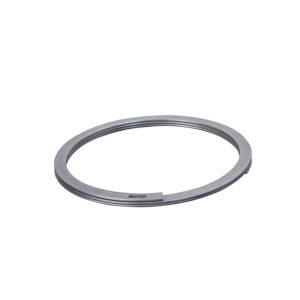
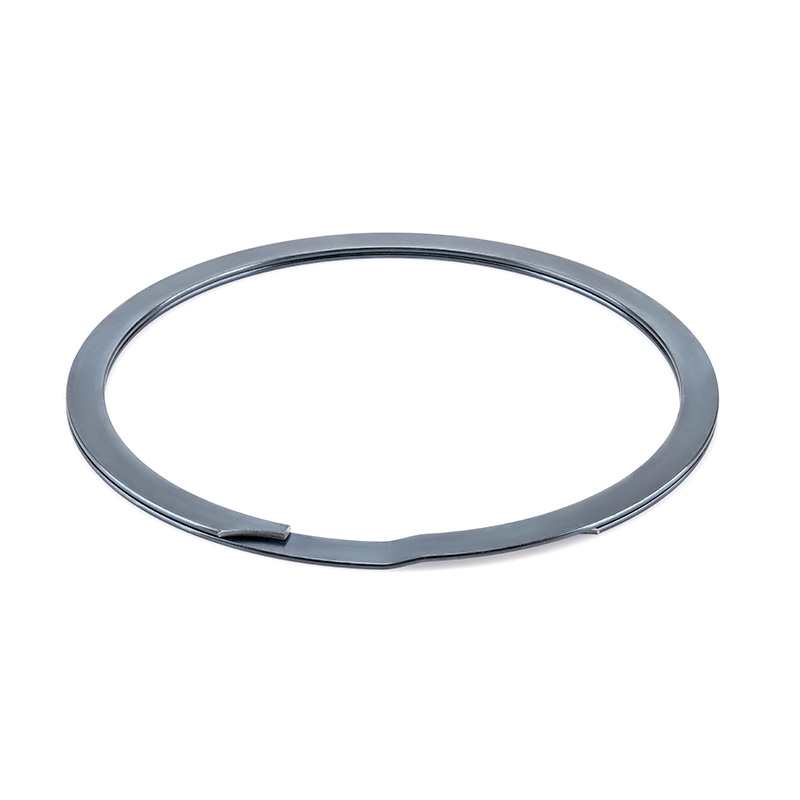
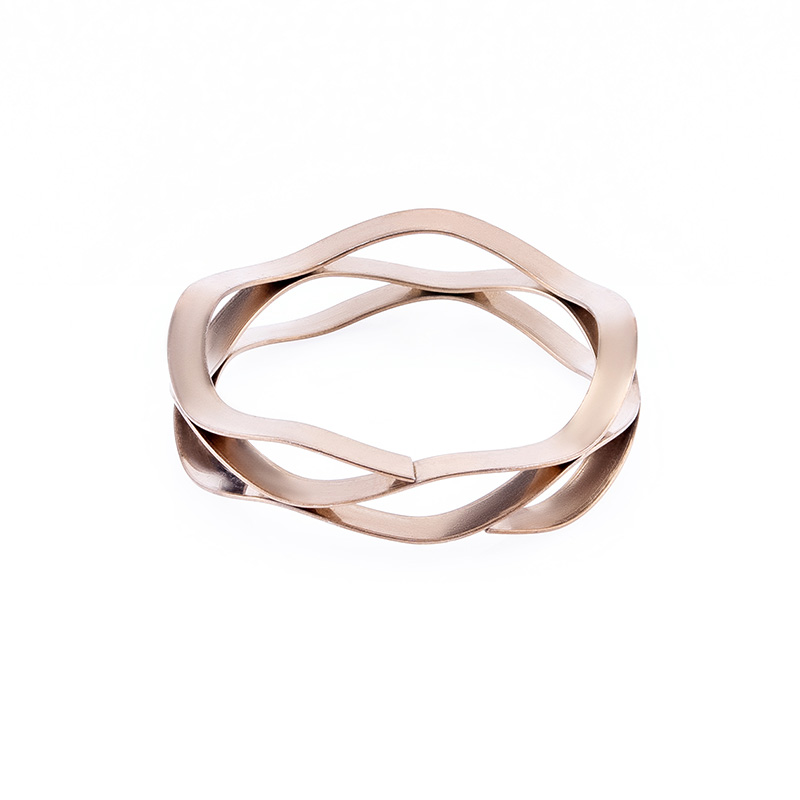
In contrast, a spiral retaining ring is formed from coiled flat wire, creating multiple turns with continuous 360° groove engagement. This geometry distributes load more evenly and improves resistance to radial expansion.
A anillo de retención espiral equilibrado combines this multi-turn structure with mass compensation features, ensuring both stable retention and reduced vibration under high-speed operation. As a result, it maintains groove engagement in conditions where conventional rings may begin to loosen or unseat.
The Real Cost of Unbalance—Vibration, Noise, and Premature Failure
In high-speed motors, even small rotational unbalance can have major consequences: vibration, noise, and component failure. Each impacts performance, reliability, and maintenance costs.
Vibration Damages Components
Unbalanced rings create wobbling in the rotating assembly, sending vibration through bearings, shafts, and housings. Over time, this accelerates bearing fatigue, shaft wear, and loosens fasteners—often leading to early motor failure. Studies show that improving balance can reduce vibration by 30% or more. A anillo de retención espiral equilibrado eliminates the mass eccentricity that causes these vibrations, stabilizing the assembly.
Noise Reduces Perceived Quality
Audible vibration is a direct quality signal to end users. Electric vehicles, power tools, and appliances sound cheaper if the motor whines or buzzes. In EVs, even minor vibration is noticeable due to low baseline noise. Balanced spiral retaining rings dampen resonance and distribute load evenly, reducing motor noise and delivering a smoother, premium user experience.
Premature Failure Increases Warranty Costs
Unbalance doesn’t just annoy users—it destroys parts. Bearings fail sooner, shafts wear unevenly, and unseated rings can trigger immediate assembly failure. Each failure translates to warranty claims, returns, and reputational damage. By addressing imbalance at the component level, a anillo de retención espiral equilibrado prevents these issues before they escalate.
Spiral vs. Stamped—A Technical Comparison
To appreciate what a anillo de retención espiral equilibrado delivers, it helps to compare spiral rings directly with traditional stamped circlips and snap rings.
| Característica | Stamped Circlip/Snap Ring | Standard Spiral Retaining Ring | Anillo de retención en espiral equilibrado |
|---|---|---|---|
| Manufacturing process | Stamped from sheet metal | Coiled from flat wire | Coiled with balancing slots |
| Radial profile | Has ears/lugs that protrude | No ears—low radial profile | No ears—low radial profile |
| Retaining surface | Partial (gap present) | 360° gapless (multi-turn) | 360° gapless |
| Mass distribution | Eccentric (gap creates imbalance) | Eccentric (gap still present) | Balanced (slots compensate for the gap) |
| High-speed resistance | Poor—can unseat above ~5,000–8,000 RPM | Moderate—better than stamped | Excellent—engineered for >15,000 RPM |
| Instalación | Requires snap ring pliers, stretched over the shaft | Spiraled on—no stretching | Spiraled on—no stretching |
| Material efficiency | Significant scrap from stamping | Minimal scrap (coiling) | Minimal scrap |
Stamped circlips have three inherent disadvantages. First, the ears take up additional radial space, potentially interfering with other components. Second, installation requires stretching the ring over the shaft diameter, putting unnecessary strain on the material. Third, the stamping process generates significant scrap, particularly for large diameters or exotic materials.
Spiral retaining rings eliminate all three problems. They have no ears to interfere with adjacent components. They install by spiraling onto the shaft, not stretching, so no strain is placed on the ring. And the coiling process produces virtually no material waste. The anillo de retención espiral equilibrado adds a fourth advantage: it eliminates the mass eccentricity that all gapped rings—stamped or spiral—otherwise possess.
Three Ways a Balanced Spiral Retaining Ring Extends Motor Life
Let’s translate the technical features into concrete benefits for your motor design.
1. Seated Retention Under Centrifugal Load
The most basic job of any retaining ring is to stay in its groove. A anillo de retención espiral equilibrado does this reliably at speeds where other rings begin to fail.
The multi-turn design provides a full 360° retaining surface that distributes centrifugal load evenly. The balancing slots prevent the ring from developing wobble that could loosen it over time. The result is a ring that remains fully seated even at 15,000 RPM and above.
2. Reduced Bearing Wear from Vibration
Bearings are among the most sensitive components in any rotating assembly. Vibration transfers uneven axial and radial loads to bearing raceways, accelerating wear and reducing servicio vida.
By eliminating vibration caused by unbalanced rings, a anillo de retención espiral equilibrado helps bearings operate under proper load conditions. The result is longer bearing life, fewer replacements, and lower maintenance costs over the motor lifecycle.
3. Consistent Clamp Load Over Time
Standard retaining rings can lose their cling—the interference fit that keeps them secure in the groove—as they undergo repeated thermal cycling and centrifugal stress. A anillo de retención espiral equilibrado maintains its geometry over time because it is never stretched during installation.
The coiled manufacturing process produces stable mechanical properties, and the balanced design ensures these properties remain consistent under operating load.
What About Locking Features? Balancing vs. Self-Locking
One common point of confusion is the difference between balancing and self-locking features. They address different failure modes, and some applications require both.
Balancing eliminates vibration. It removes mass eccentricity so the ring rotates smoothly.
Self-locking prevents unseating. It adds a mechanical feature—such as a tab engaging a slot or a dimple locking into a cut-out—that resists outward expansion under centrifugal force.
Some applications require only balancing. For example, a housing ring constrained by the bore does not need self-locking because the structure already limits movement. Other applications require both, especially in high-speed shaft systems where the ring is the only retention element.
A balanced spiral retaining ring with a locking feature combines balanced geometry with higher RPM resistance compared to LC-type interlocking rings or standard spiral rings. For EV motors, gearboxes, and high-speed spindles, this combination is often the most reliable solution.
Material and Heat Treatment—What You Need to Know
A anillo de retención espiral equilibrado performs only as well as the material it is made from. The ring must maintain elasticity under centrifugal load, resist fatigue over millions of cycles, and survive demanding operating environments.
-
Standard Material Options
Most spiral retaining rings are made from carbon spring steel or stainless steel. The selection depends on corrosion resistance and operating temperature.
Carbon spring steel offers high strength and excellent fatigue resistance at a lower cost. It is suitable for most industrial and automotive applications where corrosion exposure is limited.
Stainless steel—especially 302 and 316 grades—provides superior corrosion resistance for marine, chemical, and outdoor environments. 302 stainless steel is the standard material for many retaining ring applications. 304 stainless steel is also commonly used, though neither grade can be hardened by heat treatment.
-
Heat Treatment and Surface Finishing
After coiling, spiral retaining rings undergo heat treatment and surface finishing to achieve the required hardness and corrosion resistance. Quenching and tempering to HRC 45–55 improves hardness and elasticity.
Surface treatments such as zinc plating, zinc-nickel, or black oxide provide additional corrosion protection when required.
When specifying a anillo de retención espiral equilibrado, always confirm both material grade and heat treatment. A ring that is too soft may deform under load, while one that is too hard may become brittle and crack during installation.
Real-World Applications—Where Balanced Spiral Rings Excel
El anillo de retención espiral equilibrado is used across industries wherever high rotational speeds and reliability requirements intersect.
-
Electric Vehicle Motors
EV motors operate at speeds far beyond traditional internal combustion engine components. Shaft speeds of 15,000 RPM or more are common, and the trend continues toward higher speeds to increase power density. In this environment, any component that introduces vibration or risks unseating is unacceptable.
EV manufacturers increasingly specify anillos de retención espirales equilibrados—sometimes with self-locking features—to retain bearings and gears on motor shafts. The balanced geometry reduces motor noise, which is especially noticeable in EVs due to the absence of engine sound. The high-speed capability ensures stable performance throughout the vehicle’s service life.
-
High-Speed Spindles
Machine tool spindles operate at speeds from 10,000 RPM to over 40,000 RPM. Precision is critical. A anillo de retención espiral equilibrado in a spindle assembly must not introduce vibration that could affect machining accuracy. The balanced design ensures the ring itself does not become a source of runout, chatter, or instability.
-
Industrial Gearboxes
Gearbox assemblies require retaining rings that withstand both high rotational speeds and significant axial thrust loads. The multi-turn structure of a spiral retaining ring provides higher axial capacity than a single-turn circlip. The balanced version further reduces vibration, helping extend gear and bearing life under continuous operation.
-
Aerospace Actuators
In aerospace applications, weight is critical, and reliability is non-negotiable. Spiral retaining rings are lighter than threaded fasteners or retaining nuts, and a anillo de retención espiral equilibrado adds the high-speed stability required for actuators and rotating assemblies in aircraft systems.
Industry Standards and Balance Quality
If your motor must meet specific balance standards, the components you select—including retaining rings—must be included in that calculation.
ISO 1940-1 (now updated to ISO 21940-11) defines balance quality grades for rigid rotors. The grades range from G0.4 (highest precision, used for precision grinding spindles, gyroscopes, aerospace systems) to G4000 (lowest precision). The most common grade for small and medium industrial motors is G2.5, which corresponds to a vibration velocity of 2.5 mm/s.
A anillo de retención espiral equilibrado contributes to achieving and maintaining these grades. By eliminating the mass eccentricity inherent in gapped ring designs, it ensures the ring does not introduce an imbalance that would push the assembly outside its required tolerance.
How to Specify the Right Balanced Spiral Retaining Ring for Your Motor
When selecting a anillo de retención espiral equilibrado, work through these six parameters:
-
Shaft or housing diameter – Determines the ring size.
-
Maximum operating RPM – Dictates whether balancing alone is sufficient or a self-locking feature is required.
-
Thrust load – Multi-turn rings provide higher axial capacity than single-turn designs.
-
Environment – Corrosion exposure dictates stainless steel versus coated carbon steel.
-
Installation access – Spiral rings install axially; if axial space is limited, an interlocking LC-type ring installed radially may be a better fit.
-
Balance grade requirement – If the assembly must meet ISO G2.5 or higher, specify a balanced ring from the start.
Leading manufacturers offer custom design support with no tooling charges for modified diameters or configurations.
Preguntas más frecuentes
1. How does a balanced spiral retaining ring differ from a standard spiral ring?
A standard spiral ring still has mass eccentricity due to its gap. A balanced version adds cut-out slots opposite the gap to centralize the center of gravity, eliminating vibration-causing wobble.
2. What is the maximum RPM for a balanced spiral retaining ring?
With proper design and materials, balanced spiral rings can operate reliably at 15,000 RPM and above. Adding a self-locking feature increases RPM capacity further.
3. Can a balanced spiral retaining ring be used in both shaft and housing applications?
Yes. Both external (shaft) and internal (housing) configurations are available. Housing rings may not need self-locking because the housing constrains outward expansion.
4. What materials are available for balanced spiral retaining rings?
Carbon spring steel, 302 stainless steel, 304 stainless steel, and 316 stainless steel are standard. Other alloys can be specified for specialized environments.
5. Are balanced spiral retaining rings more expensive than standard rings?
Yes, they carry a premium over standard spiral rings due to the additional balancing operation. However, the cost is typically justified by reduced vibration, longer component life, and lower warranty claims.
Conclusión
The balanced spiral retaining ring solves a problem standard retaining rings cannot: stable high-speed rotation without vibration or unseating. It achieves this through three key features—multi-turn gapless construction, precision-balanced geometry with compensating slots, and, when required, self-locking tabs or dimples that resist centrifugal expansion.
For motor designers operating above 10,000 RPM—in EV powertrains, high-speed spindles, and industrial gearboxes—specifying a balanced spiral retaining ring is not an upgrade, but a requirement. Without it, systems face higher risks of premature bearing failure, excessive noise, and increased warranty costs that directly impact product reliability and brand reputation.
 Spanish
  English
  Chinese
  Dutch
Dutch  French
  German
  Italian
  Japanese
  Korean
  Portuguese
  Russian