
Springs have very wide applications — from cars to machinery and electronics, even medical devices. Springs can store energy; they may be used in shock absorption or for maintaining mechanical balance. Among the different types of springs commonly used in modern engineering, coil springs and wave springs happen to be two of them.
Though these may look like items performing the same function, i.e., providing elastic force, there exist differences between them with respect to design, material used for making them, application areas where they are used, and performance characteristics. Knowing these differences will help an engineer, manufacturer, as well as a buyer, select the right type of spring according to their requirement.
This paper discusses the basic differences between Coil springs and Wave springs, their working principles, how they are made, types, load capacities, and fields of application. We’ll also cover the most popular questions about materials, fatigue life, and surface treatments.
What Is a coil spring ?
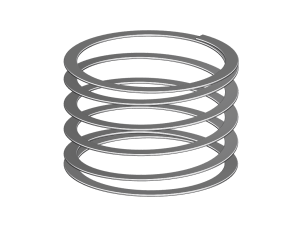
A coil spring (helical spring) is defined as that mechanical device which is created by winding wire into a helical (spiral) shape. It may be under compressive, extensive, or torsional loads and returns to its original shape when the load is removed.
Main features of coil springs:
- Made out of round or square wire-from steel material or stainless-steel material.
- Store mechanical energy through the torsion of their cross-section.
- Can be found in compression, tension, and torsion forms.
- Commonly found in auto suspensions, valves, and all kinds of equipment.
- The spring in an automobile absorbs shock from the road-that is a compression coil spring at work.
Usual Materials:
- Carbon steels (ASTM A228 Music Wire)
- Stainless Steels (302, 316)
- Alloy Steels (Chrome Silicon, Chrome Vanadium)
- Phosphor Bronze for applications requiring corrosion resistance.
- Inconel and Titanium alloys where high temperature or aerospace applications.
What Is a Wave Spring?
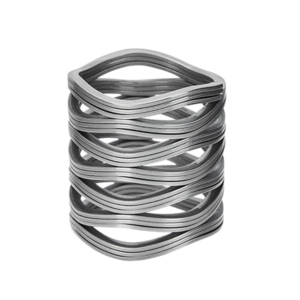
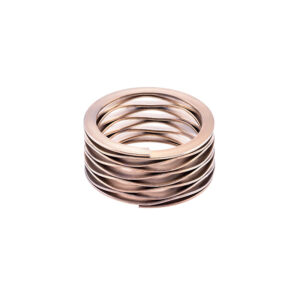
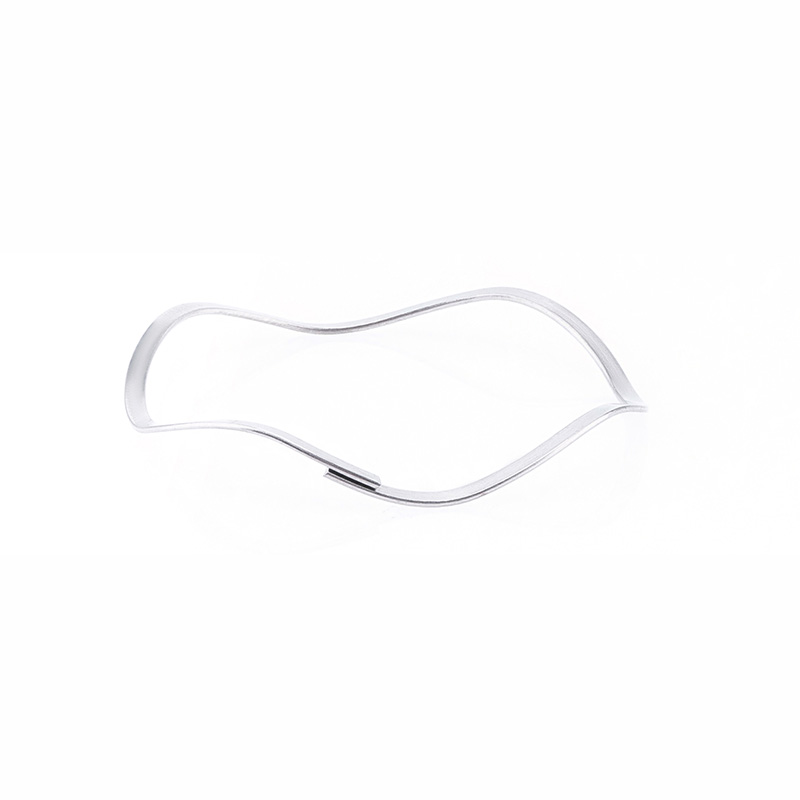
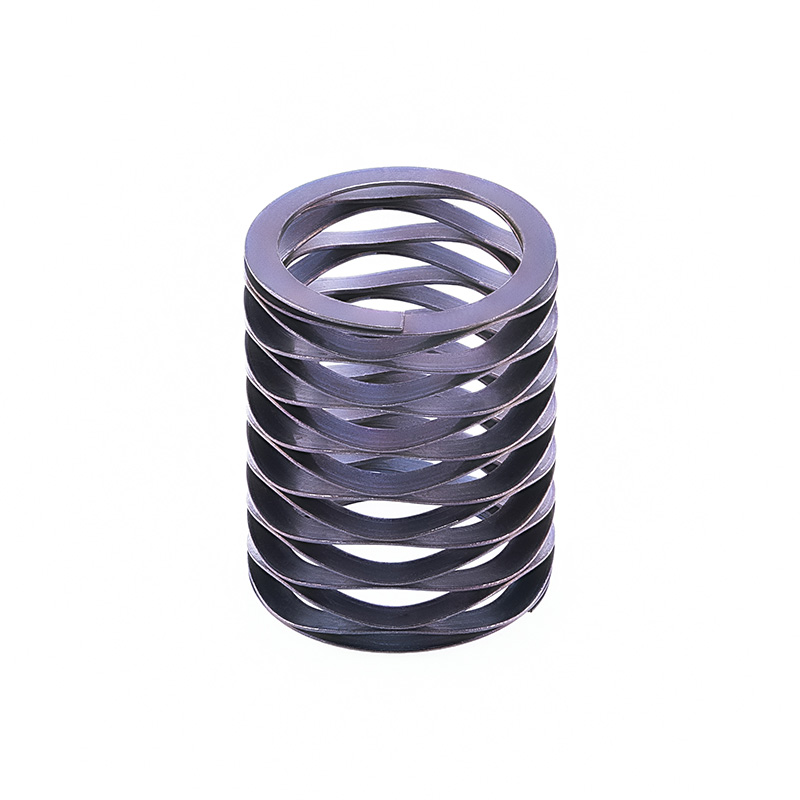
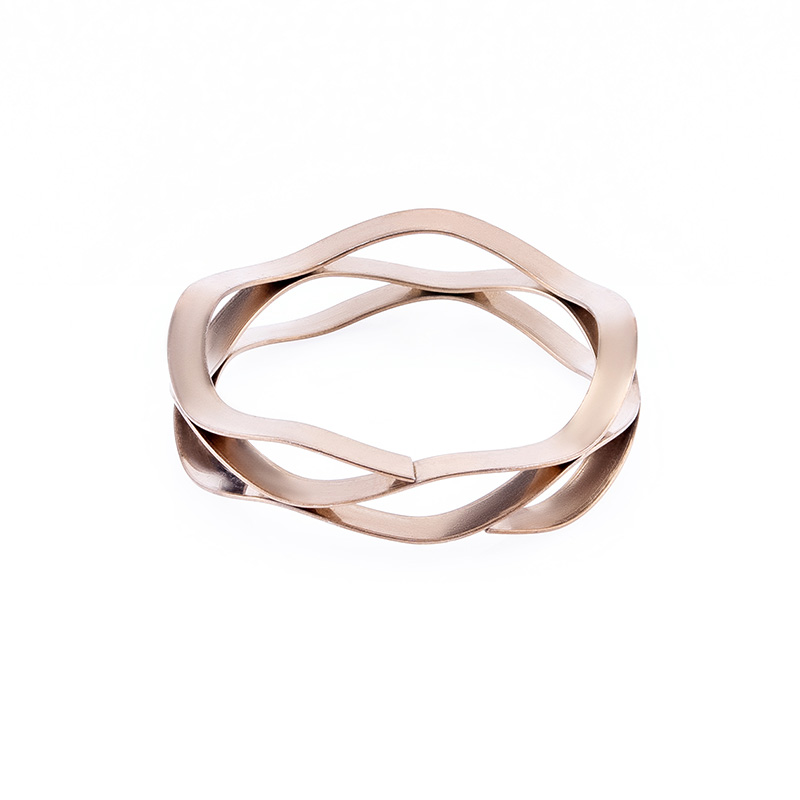
A wave spring is actually a compression flat wire spring. It is made up of a series of waves (undulations) around the circumference. It will perform the same function as a coil spring but on a much-reduced scale in axial space. Rather than round wire, material of flat ribbon-like cross-section is wound in layers with sinusoidal waves which compress under load.
Axial space savers — usually 30% to 50% shorter than a standard coil spring at the same load. Exact load and deflection characteristics. Compact mechanical assemblies: bearings, valves, electrical connectors.
Material:
- 17-7PH Stainless Steel
- Inconel X-750
- Carbon steel
- Elgiloy® or other nickel alloys that provide corrosion and heat resistance
The wave spring first got patented in the 1960s, thus revolutionizing compact mechanical systems’ design, particularly for aerospace and electronics industries.
How Do Coil Springs and Wave Springs Work?
Both springs store energy and release it but the mechanism of work varies with geometry and the shape of the wire.
Coil Spring Working Principle:
In a coil spring, when it is compressed or elongated the wire gets twisted along its helix.
The energy is stored as torsional stress within the wire.
It offers an equal and opposite force in support of its deflection, directly proportional to the amount of deflection(Hooke’s Law: F = kx).
where k is the stiffness that depends on wire diameter, coil diameter, and number of coils.
Wave Spring Working Principle:
When compressed, the wave peaks flatten and the spring’s height decreases.
The force is generated by bending of the waves, not wire torsion.
Because of its flat-wire geometry, it provides linear or near-linear load-deflection characteristics.
Multiple waves and turns can be stacked to adjust stiffness or travel.
Coil Spring and Wave Spring Manufacturing Processes
The production methods for coil and wave springs vary due to geometry and application requirements.
| Step | Coil Spring Manufacturing | Wave Spring Manufacturing |
| Material Form | Round wire | Flat wire ribbon |
| Forming Process | Cold or hot coiling | Flat coiling with wave forming |
| Heat Treatment | Stress-relief or tempering | Stress-relief and annealing |
| Surface Finish | Shot peening, polishing, plating | Deburring, edge rounding, passivation |
| Quality Control | Load testing, free length check | Load-deflection test, flatness tolerance |
Coil Spring Process:
1.The wire goes into an automatic coiling machine.
2.The coil gets wound to the required diameter and pitch.
3.Ends are ground flat for compression types.
4.Heat treatment increases elasticity and strength of the material.
5.Surface coatings or shot peening increase fatigue resistance.
Wave Spring Process:
1.Flat wire rolling and coiling into a circle.
2.Waves formed by CNC presses or forming dies.
3.Then spring is heat treated for resilience.
4.Edge finishing so there are no burrs, no sharp edges.
5.Height, load, and parallelism are the dimensions checked.
Wave springs need greater precision in manufacture because minor geometric inaccuracies can heavily influence their load performance.
Wave springs require higher manufacturing precision since small geometric errors can affect load performance.
What is the difference between coil spring and wave spring?
| Feature | Coil Spring | Wave Spring |
| Shape | Round wire, helical form | Flat wire, wavy form |
| Space Requirement | Larger axial space | Compact, space-saving |
| Deflection Range | Long stroke | Short stroke |
| Load Capacity | Higher loads possible | Moderate loads |
| Stress Distribution | Torsional stress | Bending stress |
| Manufacturing Cost | Lower (common process) | Higher (precision forming) |
| Typical Material | Carbon steel, alloy steel | Stainless or Inconel flat wire |
| Applications | Heavy-duty (automotive, machinery) | Compact (electronics, aerospace) |
| Durability | Excellent fatigue life | Excellent dimensional control |
| Surface Treatment | Shot peened, plated | Passivated, deburred |
In short:
Coil springs are ideal when long travel and heavy loads are required.
Wave springs are preferred when space-saving and precision are key.
Types of Coil and Wave Springs
Common Coil Spring Types:
- Compression Spring – resists compressive forces.
- Extension Spring – resists pulling forces (has hooks or loops).
- Torsion Spring – resists rotational forces.
- Conical Spring – has variable pitch, stable, can reduce height.
- Barrel or hourglass spring- better centering and alignment.
Common Wave Spring Types:
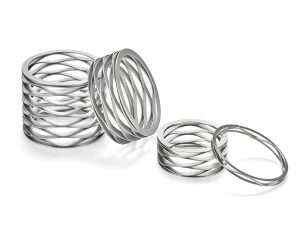
- Single-turn wave spring – simple wave profile, short deflection;
- Multi-turn wave spring – several layers of waves for greater load;
- Nested wave spring– high load in small diameter, layers stacked concentrically;
- Interlaced wave spring– alternating wave patterns for uniform compression.
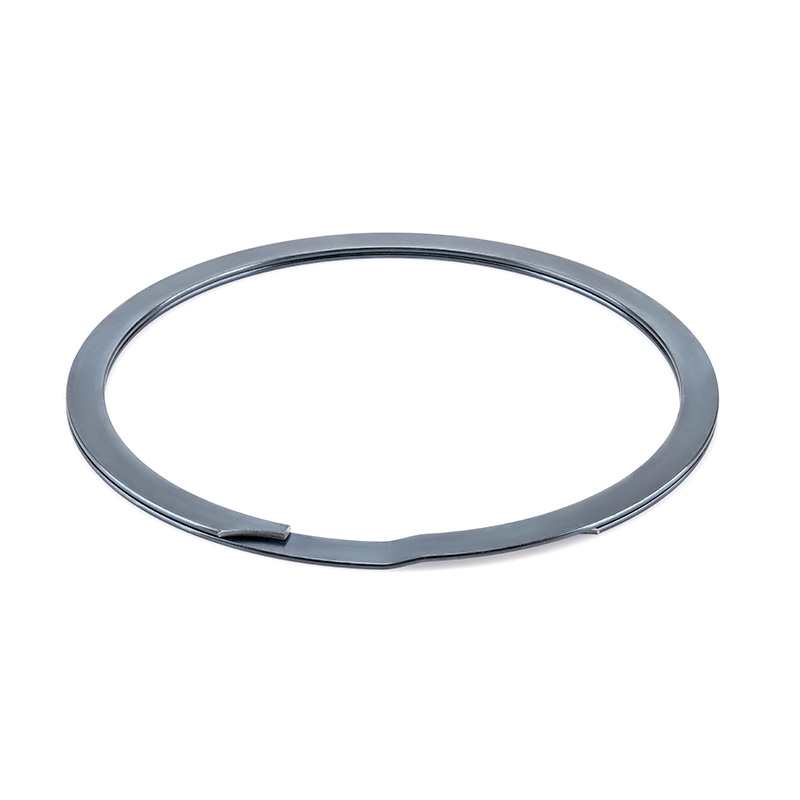
- Gap and overlap type allow axial expansion and a tight tolerance fit.
Load and Deflection Characteristics
The load each spring can bear depends on wire diameter, material, pitch, and geometry.
| Property | Coil Spring (Compression) | Wave Spring (Compression) |
| Load Range | High (up to 10,000 N or more) | Moderate (up to 2,000 N typical) |
| Deflection Range | Long stroke, up to several inches | Short stroke, compact travel |
| Spring Rate (k) | Linear or progressive | Linear or customized by design |
| Energy Storage | High | Medium |
| Space Efficiency | Low | High (up to 50% space saving) |
Wave springs often replace coil springs when compact assembly is more important than large travel distance — for example, in bearing preload or electrical contact pressure.
Features of Coil and Wave Springs
Coil Springs:
Have a long axial dimension,
Great for storing lots of energy,
Easy to make so they cost less.
A simple adjustment allows variation for any load.
Wave Springs:
Compact and lightweight
Consistent load distribution
Ideal for tight spaces
High dimensional precision
Reduced working height with same deflection
Available in stainless or exotic alloys
Wave springs are often preferred in aerospace, robotics, and electronics, where every millimeter counts.
Advantages of Coil and Wave Springs
Coil springs belong to the most popular families of mechanical springs. Mainly, metal wire is used in their production by winding it into a spiral shape. They have great elasticity and can bear loads very well. Its application covers common usage in automobiles, machinery, and electronics, electrical appliances among others.
Advantages of Coil Springs
- High Load-Bearing Capacity
High Load-Bearing Capacity, they are able to take large axial loads within a relatively small volume; therefore, most high-load, repetitive applications use them.
- Mature Manufacturing Process
Mature Manufacturing Process, since the technology of producing coil springs is very much advanced, and thus results in low cost brought by high production efficiency as well as mass production being easy plus ensuring quality control.
- Long Service Life
Mature Manufacturing Process, since the technology of producing coil springs is very much advanced, and thus results in low cost brought by high production efficiency as well as mass production being easy plus ensuring quality control.
- Good Stability
They show awesome elastic recovery features coming back fast to their initial shape after change making sure the gear works well.
- Wide Range of Applications
They are found in many applications such as car support, factory tools, impact absorption setups, electronic parts and home gadgets.
Advantages of Wave Springs
Wave springs are made from flat metal strip wound into a corrugated shape. Compared to traditional coil springs, wave springs are more compact and lightweight, making them suitable for space-constrained or precision assembly environments.
- Space Savings
About 30% to 50% of the axial space that coil springs use under the same load can be saved by using wave springs. This makes them best suited for miniaturized and lightweight designs.
- Lighter Weight
They are lighter in weight because, due to their compact structure and thinner diameter of wire, they are overall lighter.
- Uniform Mechanical Properties
Better and more uniform mechanical properties due to more uniform force distribution.
- Cost Reduction
Cost reduction In some setups, wave springs take the place of washers, retaining rings, and multi-leaf spring stacks thereby making parts simpler and lowering the general cost of production.
- Noise, Friction Reduction
The wavy contact surface of the wave spring serves as a cushion as well as a vibration absorber which reduces vibration noise hence better smoothness of operation for the system.
- Diversified Designs
Designs that may be offered include single wave springs, stacked wave springs, and spaced wave springs depending upon installation space available, load requirements to be met, and the fatigue life demanded. Forms include single wave springs, stacked wave springs, and spaced wave springs.
Applications of Coil and Wave Springs
| Industry | Coil Spring Application | Wave Spring Application |
| Automotive | Suspension, clutch, valve return | Steering systems, seat actuators |
| Aerospace | Landing gear, actuators | Bearing preload, control systems |
| Electronics | Switch mechanisms | Connectors, pressure contacts |
| Industrial Machinery | Press tools, die holders | Compact assemblies, seals |
| Medical Devices | Syringe plungers | Catheter controls, implant devices |
| Energy | Oil tools, valves | Compressors, rotary seals |
Wave springs are increasingly replacing traditional coils in next-generation compact mechanical designs.
How to Choose Between Coil and Wave Springs
1.Space Constraints:
In the presence of adequate space, a coil spring provides cost efficiency and long stroke. For limited axial space, use a wave spring.
- Load Requirement:
For high load, use coil spring. For medium or light load, wave spring is ideal.
- Operating Environment:
Use stainless or Inconel wave springs in corrosive or high-temperature environments; carbon steel coil springs suffice for general mechanical usage.
- Precision Needs:
Wave springs provide better load control when dealing with fine tolerances. Coil springs offer more flexibility and are less expensive
5.Cost Considerations:
Coil springs are low cost and easy in terms of production. Wave springs are high in cost but save assembly space plus the weight.
Usage and Handling Guidelines
Do not over-compress — it reduces the life by as much as it takes away fatigue.
Lubricate those parts which work against each other so that corrosion and wear cannot take place.
Keep it in a dry, cool place so oxidation cannot occur. Look for cracks or distortion happening regularly.
Follow design tolerances for preloads and operating deflections.
Make sure both surfaces are sitting flat and properly seated for wave springs; misalignment can give you uneven distribution of stress.
Frequently Asked Questions (FAQ)
1.How to select material — is carbon steel enough?
General mechanical applications would make carbon steel a popular choice; however, for highly corrosive environments or in high-temperature applications, it is wise to go for stainless or Inconel.
- How to choose surface treatment or anti-corrosion method?
Zinc plating or phosphate coating for carbon steel.
Stainless steel should be passivated.
Epoxy or Teflon coating for very harsh chemical environments.
- Can springs be customized (plating, magnetic, conductive, colored)?
Yes, finishes may be tailored to requirements like color coding, nonmagnetic, or conductive to fit the industry.
- How is the inspection of tolerances and dimensions defined?
Tolerance is load, deflection, and diameter dependent. DIN 2098, ASTM A228, and ISO 2162 are common standards.
- How to assess life and fatigue performance?
Carry out fatigue testing under cycled load conditions. On average, the fatigue life of steel springs is greater than 10⁵-10⁶ cycles, depending on the range of stress.
- What are typical inspection tests?
- Test load at a given deflection
- Dimensional inspection (Size and diameter)
- Surface cracks examination
- Hardness and Tensile
- Testing Salt spray test for Corrosion (Specific to springs with coating)
Conclusion
The geometry, performance, and application essentially differentiate coil springs from wave springs. Coil springs are robust, resilient, and affordable — great for heavy-duty or high-deflection uses. Wave springs offer a compact design with accurate load management suitable for contemporary minimized systems.
As long as industries are in pursuit of lightweight, efficient, and space-saving components, wave springs will continue gaining such immense popularity. The standard coil spring, however, cannot be replaced where high strength and large travel are required.
Consider the following when choosing between the two:
- Space available
- Load and deflection required
- Condition in operation
- Budget and precision needed
An engineer who knows the differences has better chances of achieving the best performance from a spring, its best service life, and mechanical reliability.
 English
  Chinese
  Dutch
Dutch  French
  German
  Italian
  Japanese
  Korean
  Portuguese
  Russian
  Spanish